Crowdsourcing turns many small contributions into big results.
When lots of people each add a little, computing can combine it into something powerful.
Crowdsourcing is the practice of obtaining contributions from a large group of people, often online. Computing makes it possible to gather, combine, and use those contributions at scale, powering everything from collaborative maps to scientific research.
This topic closes Big Idea 5: Impact of Computing. You will learn the benefits of many contributors, the challenge of quality control, and why verification matters.
Why this matters: Crowdsourcing shows how computing enables collaboration on a huge scale, and it connects directly to how many real innovations are built and improved.
Many contributors bring speed, scale, and diversity.
But quality control and verification are essential.
Crowdsourcing collects input from many people into one shared project. This powers citizen science (volunteers gathering research data), collaborative knowledge building (shared encyclopedias and maps), and open-source projects (software many people improve together). It is a form of distributed problem solving.
The benefits are real: many contributors add speed, scale, and diversity of input that no single person could match. This is sometimes called collective intelligence.
But there are challenges. Contributors have different skill levels, and not all submissions are accurate. Misinformation and low-quality data can creep in. That is why verification, checking and validating contributions, is essential to keep the result reliable.
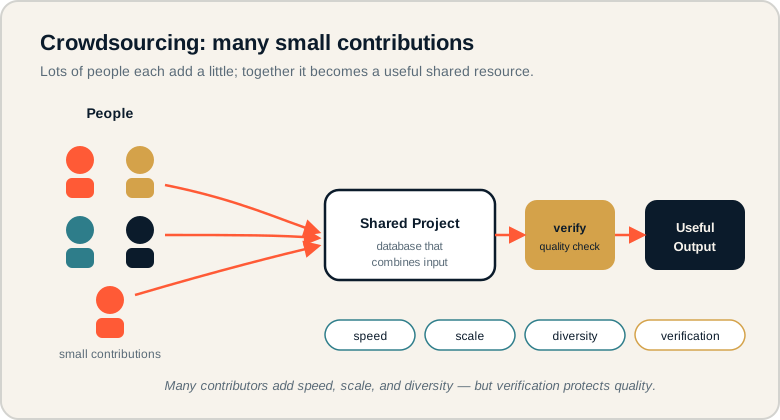
Many people send small contributions into a shared project, which is verified into useful output.
Follow the flow from many contributors to the shared project, through a verification step, to useful output. The labels highlight speed, scale, and diversity as benefits, with verification protecting quality. On the exam, mention both the benefits of many contributors and the need to verify.
The language of collaboration.
Know the forms and the safeguards.
- Crowdsourcing: gathering contributions from many people.
- Citizen science: volunteers contributing to scientific research.
- Open source: software anyone can use, study, and improve.
- Collaboration: people working together toward a shared goal.
- Verification: checking that contributions are accurate.
- Data quality: how accurate and reliable the collected data is.
- Collective intelligence: combined knowledge from many contributors.
Memory hook: Many hands make light work, but someone still has to check the work.
How crowdsourcing is tested.
Benefits balanced against quality risks.
Be ready to:
- Explain how crowdsourcing combines many contributions.
- Identify benefits like speed, scale, and diversity.
- Recognize quality and misinformation risks.
- Describe how verification improves reliability.
The exam values balanced answers: name the collaborative benefits and the steps needed to keep contributions trustworthy.
Exam tip: Crowdsourcing does not automatically guarantee accuracy. Always mention how the data is verified.
A wildlife app for bird sightings.
Analyze benefits, quality risks, and verification.
A wildlife app lets users upload bird sightings to help scientists track migration. Let's analyze it as crowdsourcing.
- Benefits: thousands of users across many locations can report sightings, giving scientists data at a scale and speed no small team could match, with great geographic diversity.
- Data quality risks: users have different skill levels, so some may misidentify birds. A few might submit incorrect or fake sightings, introducing misinformation.
- Improving reliability: verification helps, such as asking for a photo with each sighting, having experts or other users confirm identifications, flagging unlikely reports, and combining multiple reports before trusting a pattern.
The result is a powerful dataset that no single researcher could gather alone, made trustworthy by verification. This captures the core trade-off of crowdsourcing: broad participation brings huge value, but quality control is what makes the output reliable.
Crowdsourcing misconceptions.
These overlook the role of quality control.
- Thinking it always guarantees accuracy. Many contributions still need verification.
- Ignoring misinformation. Low-quality or false submissions can slip in.
- Forgetting varied skill levels. Contributors differ in expertise and care.
- Confusing it with simple voting. Crowdsourcing gathers contributions, not just opinions or clicks.
- Not explaining verification. A strong answer says how data is checked.
Reframe: Crowdsourcing gives you a flood of input. Verification turns that flood into trustworthy data.
Crowdsourcing at a glance.
Forms, benefits, and safeguards.
| Term | What it means | Example |
|---|---|---|
| Crowdsourcing | Contributions from many people | Map edits |
| Citizen science | Volunteers aiding research | Bird sighting reports |
| Open source | Shared, improvable software | Community code projects |
| Collaboration | Working toward a shared goal | Joint translations |
| Verification | Checking accuracy | Photo confirmation |
| Data quality | Accuracy of contributions | Correct identifications |
| Collective intelligence | Combined group knowledge | Shared encyclopedia |
Always pair benefits with verification.
It is the complete crowdsourcing answer.
When you discuss crowdsourcing, name the benefits of many contributors (speed, scale, diversity) and then explain how the project verifies contributions. Showing both sides demonstrates that you understand the power and the limits of collective input, which is what the exam looks for.
Try it: A community translation project lets anyone suggest translations. Name one benefit and one verification method that keeps it accurate.
Practice — attempt these now.
AP-style assessments aligned to this lesson. Time them.
AP CSP Big Idea 5 Topic 6: Crowdsourcing — Set 1
AP-style topic practice assessment
AP CSP Big Idea 5 Topic 6: Crowdsourcing — Set 2
AP-style topic practice assessment
AP CSP Big Idea 5 Topic 6: Crowdsourcing — Set 3
AP-style topic practice assessment