Ethics is responsible decision-making in computing.
Every innovation brings benefits and harms; ethics is how we weigh them.
Ethics in computing means making responsible choices about how technology is designed and used. A computing innovation can have both beneficial and harmful effects, often at the same time, and a thoughtful designer weighs those effects for everyone involved.
This topic opens Big Idea 5: Impact of Computing. You will learn to identify stakeholders, consider intended and unintended consequences, recognize trade-offs, and tell the difference between what is legal and what is ethical.
Why this matters: The Create Performance Task and the exam both ask you to analyze the effects of computing innovations on people and society.
Weigh benefits against harms for all stakeholders.
Legal and ethical are not the same thing.
A stakeholder is anyone affected by a computing innovation, including people who never use it directly. Responsible analysis asks who benefits, who could be harmed, and what trade-offs are involved. It also looks for unintended consequences, effects the designers did not plan for.
Something can be legal yet still unethical. A company may legally collect a lot of data, but doing so without clear consent can still be wrong. Good design considers fairness, safety, and inclusion, not just what the law allows.
Responsible computing also means building an inclusive culture, so that innovations work well for a wide range of people rather than only the group that created them.
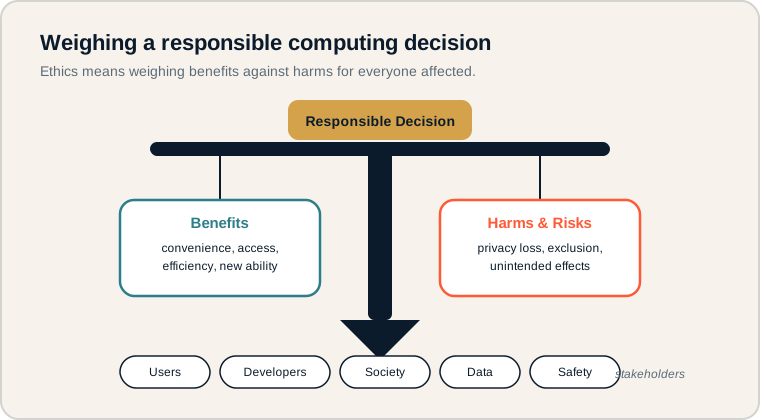
A scale weighing benefits against harms, with stakeholders shown beneath the decision.
Read the scale as a weighing of benefits on one side and harms and risks on the other. The stakeholders along the bottom remind you that many groups are affected. On the exam, a strong answer names benefits, harms, and who is impacted, rather than listing only the positives.
The language of ethical analysis.
These terms structure a strong impact answer.
- Ethics: responsible decision-making about right and wrong in computing.
- Stakeholder: anyone affected by an innovation, directly or indirectly.
- Benefit: a positive effect of a computing innovation.
- Harm: a negative effect on people or society.
- Trade-off: a gain in one area that comes with a cost in another.
- Unintended consequence: an effect the designers did not plan for.
Memory hook: Legal asks "Is it allowed?" Ethical asks "Is it right, and for whom?"
What the exam tests about ethics.
Balanced analysis of effects.
AP CSP ethics questions commonly ask you to:
- Identify both beneficial and harmful effects of an innovation.
- Name the stakeholders, including those indirectly affected.
- Describe a trade-off or an unintended consequence.
- Explain why something legal might still raise ethical concerns.
Answers that mention only benefits lose credit. The exam rewards seeing more than one side.
Exam tip: For any innovation, always state at least one benefit and one harm, then name who is affected. That structure fits most impact prompts.
A school app that tracks productivity.
Analyze benefits, harms, stakeholders, and concerns.
A school introduces an app that tracks how productive each student is during the day. Let's analyze it ethically.
- Benefits: teachers might spot students who need help, and students could see their own patterns and improve.
- Harms: constant tracking can cause stress, reduce trust, and label students unfairly based on incomplete data.
- Stakeholders: students, teachers, parents, and school administrators are all affected, and students are affected most directly.
- Ethical concerns: Was there consent? Who can see the data? Could it be misused for grading or discipline?
- Trade-off: more insight for teachers versus less privacy and autonomy for students.
The app may be perfectly legal, yet still raise serious ethical questions about privacy and fairness. A responsible design would limit what is collected, be transparent, and give students a say. This is exactly the balanced reasoning the exam expects.
Where ethics answers go wrong.
Most lose points by seeing only one side.
- Thinking legal means ethical. Something allowed by law can still be harmful or unfair.
- Discussing only benefits. A complete analysis also names harms and risks.
- Ignoring indirect stakeholders. People who do not use the system can still be affected.
- Assuming technology is neutral. Design choices shape who benefits and who is harmed.
- Forgetting unintended consequences. Real effects often go beyond what designers intended.
Reframe: Ask not just "Does it work?" but "Who does it help, who could it hurt, and was that intended?"
Ethics terms at a glance.
The building blocks of impact analysis.
| Term | What it means | Example |
|---|---|---|
| Ethical issue | A question of right and wrong | Tracking without consent |
| Stakeholder | Anyone affected | Students, parents |
| Benefit | A positive effect | Early help for students |
| Harm | A negative effect | Stress, unfair labels |
| Trade-off | Gain with a cost | Insight vs privacy |
| Unintended consequence | An unplanned effect | Used for discipline |
Use a benefit-harm-stakeholder frame.
It structures almost any impact answer.
For any innovation, jot down one benefit, one harm, and the main stakeholders before writing. This three-part frame keeps your analysis balanced and matches how AP CSP impact questions are scored. It is also useful for describing the impact of your own Create Performance Task program.
Try it: Apply the frame to a navigation app that shares live location. What is one benefit, one harm, and who are the stakeholders?
Practice — attempt these now.
AP-style assessments aligned to this lesson. Time them.
AP CSP Big Idea 5 Topic 1: Ethics — Set 1
AP-style topic practice assessment
AP CSP Big Idea 5 Topic 1: Ethics — Set 2
AP-style topic practice assessment
AP CSP Big Idea 5 Topic 1: Ethics — Set 3
AP-style topic practice assessment
AP CSP Big Idea 5 Topic 1: Ethics — Set 4
AP-style topic practice assessment