A reliable network keeps working when parts fail.
Redundancy and rerouting let the Internet survive losses, though never perfectly.
Reliability is a network's ability to keep working correctly, even when some parts fail. The Internet achieves this through redundancy (multiple paths and resources) and fault tolerance (continuing despite failures). When one route goes down, packets can reroute through another.
This topic closes Big Idea 4: Computer Systems and Networks. You will learn how redundancy supports fault tolerance, how this connects to packet switching, and why no network is perfectly reliable.
Why this matters: Reliability is why the Internet keeps running globally despite constant local failures, and it is a key idea in evaluating any computing system.
Extra paths let the network route around failure.
Redundancy makes fault tolerance possible.
Redundancy means having more than one way to do something, such as multiple network paths between two points. When a connection or router fails, redundancy provides an alternative path. This is what makes a network fault tolerant: it can keep functioning despite some failures.
This works hand in hand with packet switching. Because packets are routed independently, they can be sent along whatever paths are available. If a router goes offline, routers can forward packets through a different route to the same destination.
Redundancy also supports scalability, the ability to grow by adding more paths and resources. Still, no network is perfectly reliable: if every path between two points fails, communication stops. Fault tolerant means resilient, not failure-proof. Reliability is also distinct from speed; a network can be reliable yet slow.
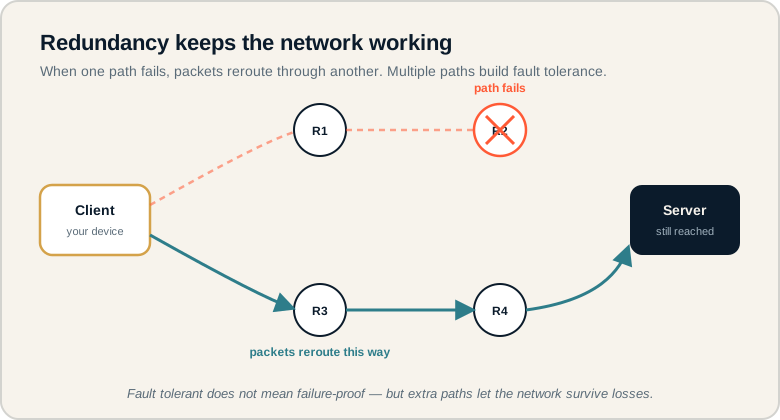
When one router path fails, packets reroute through another path to still reach the server.
Notice the top path failing at a router, marked with an X, while packets reroute along the lower path to reach the server. This is redundancy enabling fault tolerance. On the exam, connect "multiple paths" to "the network survives a failure," but remember it is not failure-proof.
The language of resilient networks.
Keep these related terms distinct.
- Reliability: the ability to keep working correctly over time.
- Redundancy: having backup paths or resources available.
- Fault tolerance: continuing to function despite some failures.
- Scalability: the ability to grow to handle more demand.
- Failure: when a part of the network stops working.
- Rerouting: sending data along a different path when one fails.
Memory hook: Redundancy is the spare route; fault tolerance is using it to keep going when the main route breaks.
How network reliability is tested.
Redundancy, fault tolerance, and their limits.
Be ready to:
- Explain how redundancy provides fault tolerance.
- Describe how packets reroute when a path fails.
- Connect packet switching to reliability.
- Recognize that fault tolerant does not mean failure-proof.
Questions often describe a router or link failing and ask why communication can still succeed, or what the limits of that resilience are.
Exam tip: The strongest answers name redundancy as the cause and rerouting as the mechanism, while noting that enough failures can still break communication.
A router fails during a web request.
How communication can continue.
A router goes offline during a web request or video call. How might redundancy allow communication to continue?
- Failure detected: the path through the failed router is no longer usable.
- Alternative path: because the network has redundancy, other routers offer a different route to the same destination.
- Rerouting: packets are forwarded along the working path. Thanks to packet switching, each packet can independently take this new route.
- Reassembly: the destination still receives all the packets and reassembles them, so the page loads or the call continues.
This shows fault tolerance in action: a single failure does not break the connection because alternatives exist. However, if every available path failed, communication would stop. Redundancy improves resilience but cannot make a network perfectly reliable.
Reliability misconceptions.
These overstate or misunderstand resilience.
- Thinking redundancy means duplicate data only. It mainly refers to backup paths and resources, not just copies.
- Thinking fault tolerant means failure-proof. It means resilient to some failures, not all.
- Assuming one failed router breaks the Internet. Alternative paths usually keep things running.
- Ignoring scalability. Reliability also depends on growing to meet demand.
- Confusing reliability with speed. A reliable network is not necessarily a fast one.
Reframe: Redundancy is like having several roads to the same town. Lose one and you still arrive, but a total washout still stops you.
Reliability concepts at a glance.
Keep these ideas separate.
| Term | What it means | Example |
|---|---|---|
| Reliability | Keeps working correctly | Site stays reachable |
| Redundancy | Backup paths or resources | Multiple routes |
| Fault tolerance | Works despite failures | Survives a router outage |
| Scalability | Grows with demand | Adding more servers |
| Failure | A part stops working | A router goes offline |
| Rerouting | Using a different path | Packets take a new route |
Pair the benefit with its limit.
Redundancy helps, but it is not absolute.
When you explain reliability, state both the strength and the limit: redundancy enables rerouting so the network tolerates failures, but enough simultaneous failures can still cut communication. Showing both sides demonstrates the balanced reasoning AP CSP rewards in network questions.
Try it: Describe one way redundancy helps a video call survive a network problem, and one situation where it would not be enough.
Practice — attempt these now.
AP-style assessments aligned to this lesson. Time them.
AP CSP Big Idea 4 Topic 7: Network Reliability — Set 1
AP-style topic practice assessment
AP CSP Big Idea 4 Topic 7: Network Reliability — Set 2
AP-style topic practice assessment
AP CSP Big Idea 4 Topic 7: Network Reliability — Set 3
AP-style topic practice assessment