Intellectual property protects creative work.
Code, images, music, and writing belong to their creators, with rules for reuse.
Intellectual property (IP) is creative or original work that is owned or protected by law. This includes code, images, music, and writing. Rules like copyright, licensing, and fair use decide who may use a work and how.
This topic is part of Big Idea 5: Impact of Computing. You will learn the difference between giving credit and having permission, and how to reuse digital work responsibly.
Why this matters: The Create Performance Task requires you to use media and code responsibly, with proper permission and attribution. IP rules apply directly to your own project.
Permission and credit are different things.
Licenses set the terms; attribution gives credit.
Copyright automatically protects original work, giving the creator control over how it is used. A license states the terms under which others may use that work. Creative Commons licenses are a popular way for creators to grant specific permissions, such as allowing reuse with attribution.
Some work is in the public domain, meaning it is no longer protected and can be freely used. Fair use allows limited use of copyrighted material in certain situations, such as commentary or education, but it is limited and situational.
The most important distinction: attribution (crediting the creator) is not the same as permission. Citing a source does not automatically give you the right to use it. Using someone's work without permission or credit can be plagiarism or copyright infringement.
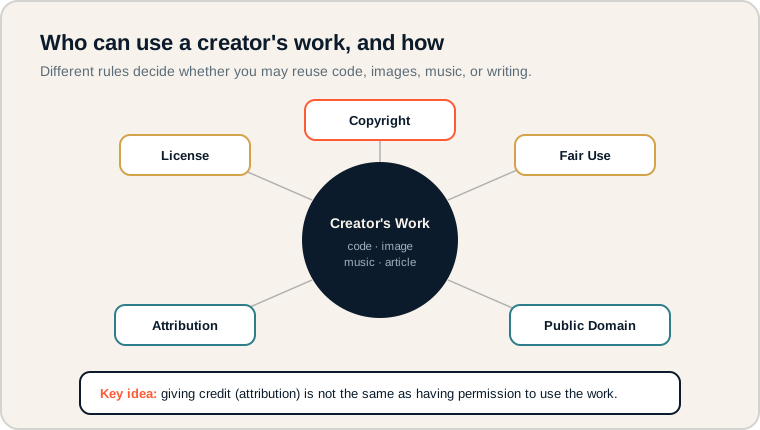
A creator's work surrounded by the rules that govern its reuse.
The work sits at the center, with copyright, license, attribution, public domain, and fair use around it. Each is a different rule about reuse. On the exam, remember the footer's key idea: giving credit is not the same as having permission.
The rules of reuse.
Know what each term permits.
- Copyright: legal protection giving creators control over their work.
- License: terms stating how others may use a work.
- Creative Commons: licenses that grant specific reuse permissions.
- Public domain: work no longer protected, free for anyone to use.
- Fair use: limited use of protected work in certain situations.
- Attribution: crediting the original creator.
- Plagiarism: using others' work as your own without credit.
Memory hook: Permission says "you may use it." Attribution says "here is who made it." You often need both.
How intellectual property is tested.
Permission, licensing, and responsible reuse.
Be ready to:
- Explain what copyright protects.
- Decide whether a use needs permission, attribution, or both.
- Recognize Creative Commons and public domain.
- Identify responsible reuse for a project.
The Create Performance Task specifically expects you to use legally acquired media and to credit sources, so this knowledge is directly assessed.
Exam tip: "Found online" does not mean "free to use." Check the license before reusing any image, sound, or code.
Building a website with online media.
What is allowed, what needs permission, what needs credit.
A student builds a website and wants to use images, music, and code snippets found online. What is allowed?
- Images: a copyrighted photo needs permission or a license. An image under Creative Commons may be used if the student follows the license, which often requires attribution. A public domain image can be used freely.
- Music: most popular music is copyrighted and needs a license. The student should choose royalty-free or Creative Commons music and follow its terms.
- Code snippets: code also has licenses. Some open-source licenses allow reuse with attribution; others have more conditions. Copying code without checking the license or understanding it is risky and may be plagiarism.
The responsible approach is to check each item's license, get permission where required, and provide attribution even when the license allows free use. Remember: attribution alone does not grant permission if the license does not allow the use.
Intellectual property misconceptions.
These lead to accidental infringement.
- Thinking everything online is free. Most content is copyrighted by default.
- Thinking attribution gives permission. Credit is not the same as the right to use.
- Copying code without credit or understanding. Code has licenses and should be understood and attributed.
- Confusing public domain with free download. Being downloadable does not mean it is public domain.
- Ignoring software license terms. Licenses set real conditions you must follow.
Reframe: Before reusing anything, ask two questions: Am I allowed to use this? Have I credited the creator?
Intellectual property at a glance.
What each rule means for reuse.
| Term | What it means | For reuse |
|---|---|---|
| Copyright | Creator's legal control | Usually need permission |
| License | Terms for use | Follow the stated terms |
| Creative Commons | Preset permission licenses | Use per the license |
| Public domain | No longer protected | Free to use |
| Fair use | Limited protected use | Situational, limited |
| Attribution | Crediting the creator | Often required, not enough alone |
| Plagiarism | Using work as your own | Never acceptable |
Check the license, then attribute.
Two steps that keep your project clean.
For every piece of media or code you reuse, first confirm the license permits your use, then add proper attribution. Doing both protects you from infringement and meets the Create Performance Task requirement to use and acknowledge sources responsibly.
Try it: You find a song labeled "Creative Commons, attribution required." What two things must you do to use it correctly?
Practice — attempt these now.
AP-style assessments aligned to this lesson. Time them.
AP CSP Big Idea 5 Topic 4: Intellectual Property — Set 1
AP-style topic practice assessment
AP CSP Big Idea 5 Topic 4: Intellectual Property — Set 2
AP-style topic practice assessment
AP CSP Big Idea 5 Topic 4: Intellectual Property — Set 3
AP-style topic practice assessment