Great programs are not written, they are rewritten.
Almost no real software is finished on the first try. It grows in versions.
Iterative development means building a program in repeated cycles, each one improving on the last. You start with a prototype, test it, gather feedback, and revise, then do it all again. Each loop produces a better version.
This is how professional software is made, and it is the natural conclusion of Big Idea 1: Creative Development. The problem-solving, design, abstraction, and testing skills from earlier topics all come together here.
Why this matters: The Create Performance Task is itself an iterative project. You are expected to develop, test, and refine your program over time, exactly the process described here.
Prototype, test, feedback, revise, repeat.
Small improvements, made repeatedly, add up to a strong program.
Iterative development replaces the impossible goal of "build it perfectly the first time" with a realistic loop:
- Prototype: build a simple working version of the core idea.
- Test: check that it behaves correctly, including edge cases.
- Feedback: let real users try it and tell you what works and what does not.
- Revise: make focused improvements based on what you learned.
- Improve and repeat: add the next feature and loop again.
Each cycle adds value while keeping the program working. Crucially, you add features incrementally, testing old behavior each time so new changes do not quietly break what already worked.
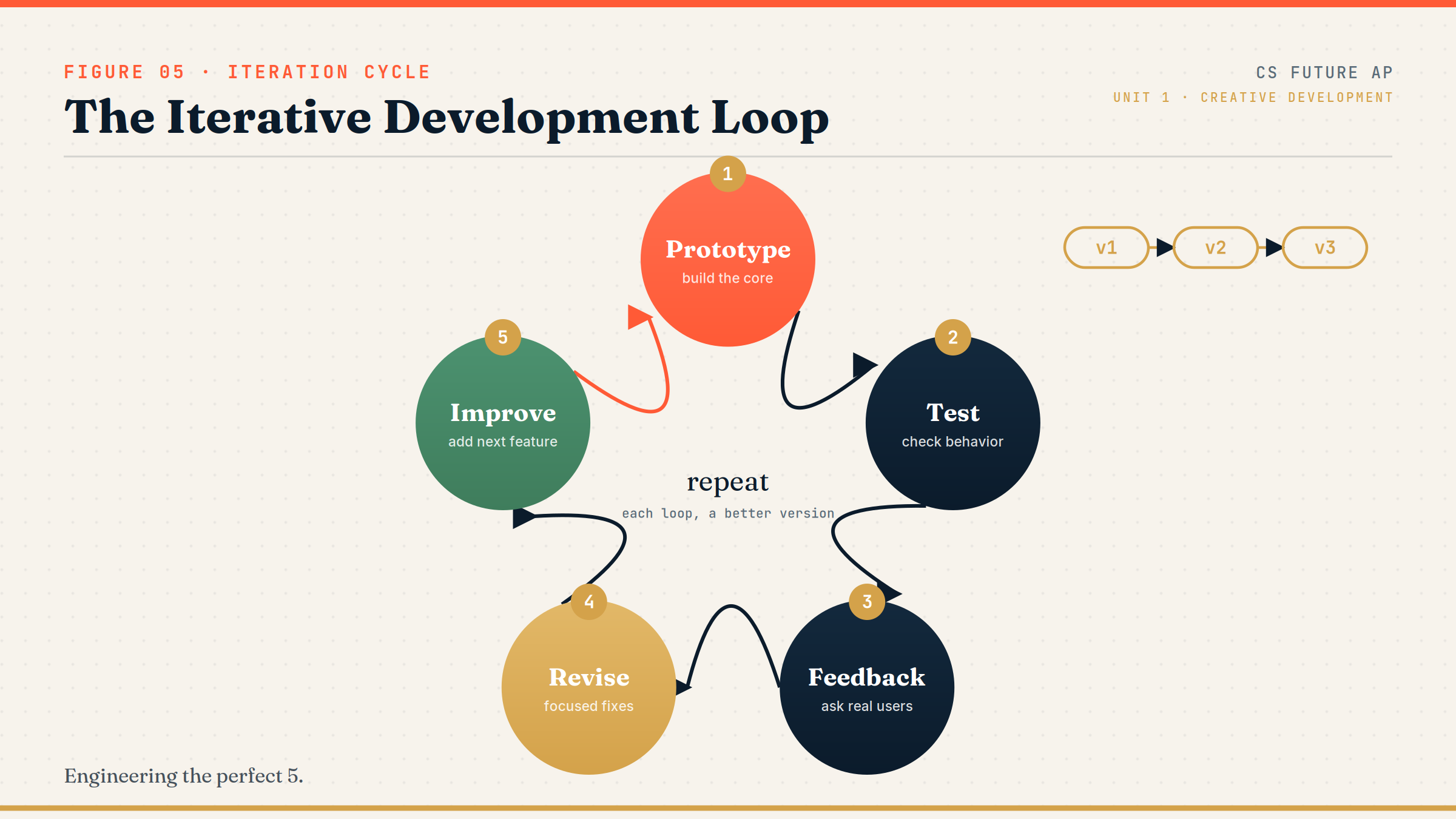
The development loop: Prototype → Test → Feedback → Revise → Improve → Repeat.
This loop never truly ends; it just produces better versions each time around. Read it as a spiral rather than a circle: each pass leaves the program more capable than before. On the exam, recognize that iteration is ongoing and feedback-driven, not a single polish step at the end.
The vocabulary of improvement.
Know the difference between a draft, a prototype, and a final version.
- Iterative development: building and improving a program through repeated cycles.
- Prototype: an early, simplified working version used to test and gather feedback.
- Iteration: one full pass through the build-test-revise cycle.
- Refinement: making targeted improvements to existing behavior or design.
- Feedback: input from users or testing that guides the next iteration.
- Incremental development: adding features a little at a time while keeping the program working.
Memory hook: A prototype is a rough sketch, an iteration is one round of polishing, and the final version is the result of many rounds.
How iteration appears on the exam.
And why it is central to the Create Performance Task.
Be ready to:
- Explain why programs are developed iteratively rather than all at once.
- Identify how user feedback drives the next round of changes.
- Recognize the value of incremental feature development with testing along the way.
- Describe how a program improved from one version to the next.
The Create Performance Task directly rewards describing your development process, including how you identified and fixed difficulties along the way. Iteration gives you that story.
Exam tip: When a question describes adding features over time and responding to feedback, the concept being tested is almost always iterative development.
Improving a quiz app across three versions.
Watch one program grow through iteration.
A student builds a quiz app and improves it over three iterations:
- Version 1: asks questions and shows a final score. This is the prototype, the smallest version that proves the core idea works.
- Version 2: after testing, the student adds feedback for wrong answers so users learn from mistakes. Existing scoring is retested to confirm it still works.
- Version 3: based on user feedback, the app now stores progress and recommends review topics, making it genuinely useful for studying.
Each version is complete and working, just less capable than the next. The student never tried to build Version 3 first. That would have been overwhelming and hard to test. Instead, each iteration added one meaningful improvement and confirmed the earlier features still worked.
Notice: This is exactly the kind of development story the Create Performance Task asks you to tell, a clear path from a simple prototype to a refined, useful program.
Where iteration goes wrong.
Even good developers slip into these traps.
- Building the final version immediately. Skipping prototypes leads to overwhelming, hard-to-test code.
- Ignoring feedback. Iteration without listening to users is just busywork.
- Adding features without testing old ones. New code can silently break what already worked.
- Changing design without a reason. Revisions should respond to real problems or feedback, not whims.
- Not documenting improvements. If you cannot describe how the program improved, you lose easy Create Task points.
Reframe: Each iteration should answer "What is the one most valuable improvement I can make and test right now?"
Stages of an evolving program.
From first draft to final version.
| Stage | What it is | Quiz app example |
|---|---|---|
| First draft | The earliest rough attempt | Questions sketched on paper |
| Prototype | Simple working version of the core idea | Version 1: ask and score |
| Iteration | One full build-test-revise cycle | Adding answer feedback |
| Refinement | Targeted improvement to existing behavior | Clearer wrong-answer messages |
| Feedback | User or test input guiding changes | Users want progress saved |
| Final version | The refined result of many iterations | Version 3: progress + review tips |
Keep a short development log.
A few lines per version makes the Create Task far easier.
Each time you change your program, write one or two lines: what you added, what problem it solved, and how you tested it. This log becomes the backbone of your written responses on the Create Performance Task, where you must describe how your program developed and how you overcame difficulties.
Try it: Plan any app as three versions on paper. Decide the single most important feature for Version 1, then what each later version adds.
Practice — attempt these now.
AP-style assessments aligned to this lesson. Time them.
AP CSP Big Idea 1 Topic 5: Iterative Development — Set 1
AP-style topic practice assessment
AP CSP Big Idea 1 Topic 5: Iterative Development — Set 2
AP-style topic practice assessment
AP CSP Big Idea 1 Topic 5: Iterative Development — Set 3
AP-style topic practice assessment
AP CSP Big Idea 1 Topic 5: Iterative Development — Set 4
AP-style topic practice assessment